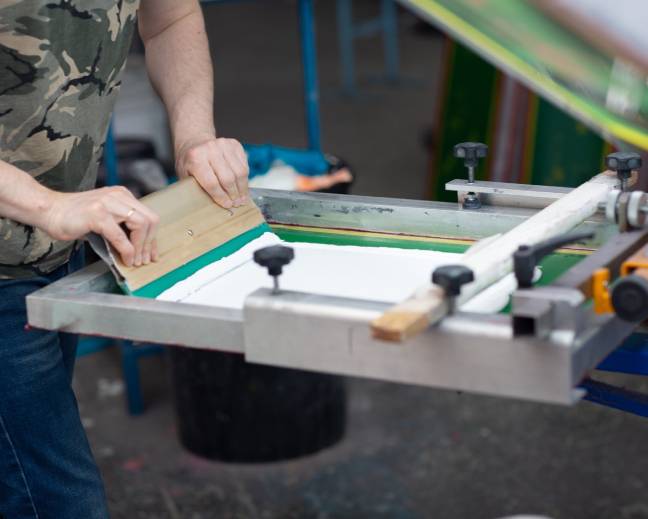
Textile screen printing is a highly technical process, and even experienced printers encounter recurring challenges that affect print quality, production efficiency, and garment durability. Understanding the root cause of each problem — and knowing the right solution — is essential for consistent, professional results.
At Karan Texchem, we work closely with garment manufacturers and textile printers to address the most common screen printing problems with precise chemical solutions and practical process guidance.
Below are the most common problems faced in textile screen printing and how to solve them effectively:
“Every printing problem has a root cause. Understanding the chemistry behind each issue is the fastest path to a lasting solution.” -Karan Texchem
01. White Ink Not Covering Dark Fabric — Ground Visible After 2+2 Strokes
The Problem
When printing white on dark dyed fabric, the ground colour remains visible even after applying two flood strokes and two print strokes. This is one of the most common complaints in garment screen printing, especially on black or navy base fabrics.
Precaution
Avoid overprinting with extra strokes, as excessive ink build-up may result in tackiness in the print and poor curing performance.
Solution
- Use a high-opaque white ink such as Plastex White for maximum ground coverage
- Check ink viscosity — if the ink is too loose or runny, add 1–2% thickener under stirring to improve body and opacity
- If possible, use a lower screen mesh such as 100 mesh/inch for better ink deposition and coverage on dark fabrics
02. Ink Viscosity Too Thick
The Problem
The ink is too stiff or heavy to print smoothly through the screen, causing dragging, uneven ink release, or poor detail reproduction. This is particularly common in cold weather conditions or when ink has been stored for extended periods.
Precaution
Avoid using binder for dilution, as it may be a different formulation from the one already used in the ink and can cause compatibility issues, phase separation, or changes in print quality.
Solution
- Add 2–3% water under gentle stirring to reduce viscosity to the desired level
- Alternatively, add diluted glacial acetic acid in small increments to adjust viscosity while maintaining ink stability
03. Screen Choking or Blocking During Printing
The Problem
The screen mesh clogs or blocks during the print run, causing patchy prints, missing fine details, or complete stoppage. Screen choking is commonly caused by ink drying in the mesh, especially in hot and dry printing environments or when production pauses are frequent.
Precaution
Avoid using binder or any other auxiliary chemical directly into the ink to solve choking, as these can alter the ink’s rheology and worsen the problem over time.
Solution
- Add 2–3% polypropylene glycol or diethylene glycol into the ink — these humectants slow down ink drying inside the screen mesh, preventing blocking during the print run
- Keep screen flood strokes consistent between prints to maintain ink flow
- If choking persists, clean the screen immediately with appropriate screen wash and restart with fresh ink
04. How to Choose the Right Ink for Your Fabric Type
The Problem
Using the wrong ink for the fabric type results in poor adhesion, colour inconsistency, cracking after washing, or reduced print durability. Different fabrics have different surface energies and stretch characteristics that require specific ink formulations.
Solution
- For standard black printing on any base fabric, always use a ready black ink such as Plastex Black for consistent opacity and smooth runnability across production runs
- For high-stretch fabrics such as lycra, elastane blends, or spandex, use Texaprint KL or Texaprint KBL — these specialist inks are formulated to flex with the fabric without cracking, peeling, or losing adhesion through repeated wash cycles
- Always test ink-fabric compatibility on a small sample before full production to verify adhesion, stretch performance, and wash fastness
05. What Mesh Count Should I Use for Screen Printing?
The Problem
Choosing the wrong mesh count leads to either insufficient ink deposition (too fine a mesh) or loss of fine print detail (too coarse a mesh). Getting the mesh count right is critical for achieving the desired print quality and ink coverage.
Solution
- For opaque or heavy white inks printing on dark fabrics, use a coarser mesh of approximately 100 mesh/inch to allow maximum ink deposition and achieve solid, opaque coverage
- For fine-detail prints, intricate designs, or halftone work, use a higher mesh count in the range of 140–160 mesh/inch for sharper image reproduction
- Always match mesh count to your specific ink viscosity and design complexity — a heavier ink requires a coarser mesh, while a thinner ink suits a finer mesh
- When in doubt, run a mesh test on a sample fabric before committing to a full production run
“Consistent print quality starts with understanding your materials. The right ink, the right mesh, and the right process parameters make all the difference in professional textile screen printing.” -Karan Texchem Technical Team
Conclusion
Textile screen printing problems are manageable when you understand the chemistry and process variables behind them. From ink opacity and viscosity to screen choking and mesh selection, each challenge has a precise, practical solution.
By using the right printing auxiliaries, maintaining proper ink viscosity, and selecting the correct mesh count for each job, garment printers can achieve consistently high-quality results across all fabric types and print effects.
Karan Texchem provides advanced textile printing inks, specialty auxiliaries, and technical support to help garment manufacturers and screen printers overcome production challenges and deliver premium print quality on every garment.